Cultural Triangle

Anuradhapura

Twenty-three centuries of worship beneath white domes

Region
Cultural Triangle
Best time
Anuradhapura is dry-zone hot all year, typically 30–34°C by day with a fierce midday sun. December to March is the most comfortable window; May to September is hotter but gloriously dry under big skies. In June, the Poson full moon brings hundreds of thousands of pilgrims to the city and to Mihintale — profoundly atmospheric if you plan ahead, congested if you don't. Brief rains are possible around October to December.

Why Anuradhapura belongs on your route

For well over a thousand years, from around the fourth century BCE, Anuradhapura was the capital of Sri Lanka and one of the great cities of the ancient world — monasteries for thousands of monks, palaces, reservoirs and stupas the size of hills, all spread across a sacred plain. Abandoned to the jungle in the eleventh century and brought back to light from the nineteenth, it is today a UNESCO World Heritage Site and, more remarkably, a living place of pilgrimage.

The modern town sits beside the ruins, and the sacred city still hums: white-clad families make the circuit of the great stupas at dawn, and the Sri Maha Bodhi — a sacred fig planted over 2,300 years ago — receives offerings without interruption. Cycling between the sites beneath a canopy of trees, it feels less like sightseeing and more like joining a very long conversation.

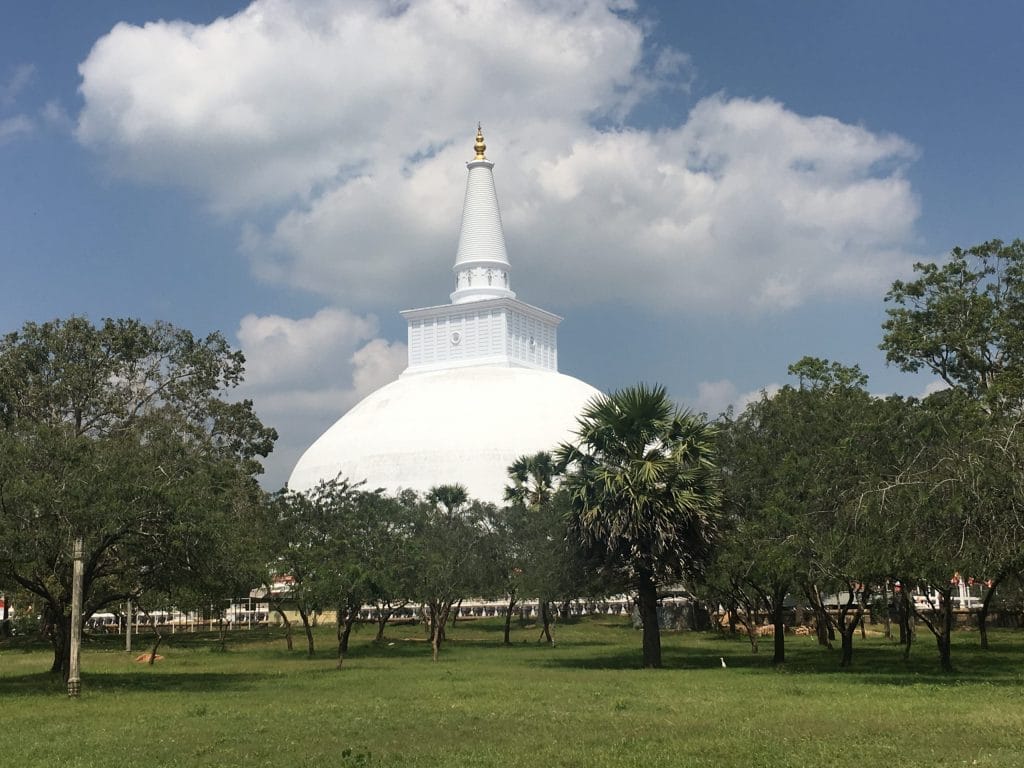
  • The scale of ambition is breathtaking. Jetavanaramaya's brick dome, raised in the early centuries CE, once stood among the tallest structures of the ancient world; Ruwanwelisaya gleams white above its encircling elephant wall; Abhayagiri spreads monastic ruins over hectare upon hectare. Nowhere else on the island shows Buddhist civilisation at this scale.
  • The Sri Maha Bodhi is a sapling of the tree under which the Buddha attained enlightenment, brought from India in the third century BCE and planted here — widely considered the oldest historically documented living tree in the world, tended continuously for more than two millennia. Standing among the pilgrims at evening puja is one of Sri Lanka's most moving experiences.
  • Anuradhapura rewards unhurried time better than the region's single-monument sites. The sacred city is flat, leafy and made for cycling — moonstones, guard stones, twin ponds and museum collections all slot between the great domes — and the pilgrimage mountain of Mihintale waits just 12 kilometres east.

Things to do

Experiences we arrange around Anuradhapura

The Sri Maha Bodhi at puja

Join the stream of pilgrims in white carrying lotus and oil lamps to the sacred fig on its golden terrace. Morning and evening pujas are the most atmospheric hours; stand back, observe quietly and let the ritual unfold around you.
The great stupas

Walk the sand platforms of Ruwanwelisaya with its encircling elephant wall, then stand beneath Jetavanaramaya — once among the tallest structures of the ancient world — and do the maths on its millions of bricks. Abhayagiri, the third of the giants, is where monastic life is easiest to imagine.

Moonstones, guard stones and the twin ponds

Hunt out the island's finest carved moonstone — a semicircle of elephants, horses and geese symbolising the stages of enlightenment — along with the guard stones, the Kuttam Pokuna twin bathing ponds and the famous lovers carving at Isurumuniya.

Cycle the sacred city

Three to four easy, flat hours on a bicycle (or by tuk-tuk) link the sites along tree-shaded roads. Your driver can follow with water and shade, meeting you at each gate — the kindest way to cover Anuradhapura's spread.

Mihintale at golden hour

The mountain where Buddhism arrived in Sri Lanka in the third century BCE rises 12 kilometres east, its great granite staircases climbing past dagobas to wind-swept views over the tank-dotted plains. Go before 9 am or after 4 pm to keep the stone cool underfoot.

Getting there with your driver

Anuradhapura lies approximately 205 kilometres from Colombo — roughly 4.5–5.5 hours depending on traffic — and about 180 kilometres (4–4.5 hours) from Bandaranaike Airport.

From Sigiriya it is roughly 85 kilometres (about 2 hours); from Dambulla about 65 kilometres (roughly 1.5 hours); from Polonnaruwa roughly 100 kilometres (2–2.5 hours) — the island's ancient cities chain together naturally.

From Trincomalee and the east coast it is approximately 110 kilometres (about 2.5 hours), and from Kandy roughly 140 kilometres (3.5–4 hours) via Matale and Dambulla, with the spice gardens of Matale as a welcome break.

Commonly combined with Colombo, Airport (CMB), Negombo, Kandy.

Know before you go

  • The sacred precinct has a dress code — shoulders and knees covered, even while cycling, and shoes off at every stupa. Carry socks; the sand and flagstones get hot.
  • The sites spread across several kilometres of flat roads, so a bicycle or tuk-tuk loop beats walking; your driver can meet you at each gate with cold water.
  • Start at dawn or after 4 pm — the light is beautiful and the midday heat punishing; carry more water than you think you need.
  • Wearing white, like the pilgrims, is a quiet mark of respect and helps with the sun as well.
  • Combine the city with Mihintale in the afternoon, and give the site museum an hour for the story of the excavations.

Private tours

Journeys that include Anuradhapura

Begin your journey

Want Anuradhapura in your itinerary?

Tell us how long you have and what you love — we'll shape a private journey around Anuradhapura and the rest of the island.